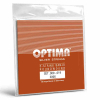
Optima Tenor Banjo Silver Strings 2705.K is a German-made four-string set for tenor banjo with Ball End attachments. Designed for traditional C–G–D–A tuning in fifths, the set combines plain steel A and D strings with silver-plated wound G and C strings.
The Silver Strings range offers a characteristic tenor-banjo sound with clearly defined attack, expressive articulation and traditional metallic brightness. The silver-plated copper winding of the lower strings adds a smoother, more rounded tonal quality.
Check the attachment: part number 2705.K includes ball ends on all four strings. If your tailpiece requires loops, choose Optima 2705 (Loop End) instead.
Materials and sound
A and D — Silver Steel. The two treble strings use plain steel wire for direct response and a clearly defined tone. Silver Steel refers to a type of steel wire, not silver plating.
G and C — silver-plated copper winding. A steel core with silver-plated copper winding supplies additional string mass for the lower register while retaining practical overall diameters.
Optima describes its silver-plated banjo strings as smoother-sounding than conventional phosphor bronze-wound strings, while preserving the characteristic banjo twang and clearly articulated attack.
The set is suitable for traditional jazz, Dixieland, rhythmic accompaniment and melodic playing on appropriately tuned tenor banjos. The final sound also depends on head tension, bridge position, scale length and playing technique.
String gauges and contents
| String |
Gauge |
Construction |
Single-string part no. |
| 1 — A |
.009″ |
Plain Silver Steel |
2701K |
| 2 — D |
.012″ |
Plain Silver Steel |
2702K |
| 3 — G |
.022″ |
Silver-plated copper wound |
2703K |
| 4 — C |
.031″ |
Silver-plated copper wound |
2704K |
String gauges are given in inches, equivalent to approximately 0.229 / 0.305 / 0.559 / 0.787 mm. For wound strings, the gauge refers to the outside diameter including winding.
Standard C–G–D–A tuning
The conventional tenor banjo is tuned in fifths, from lowest to highest C–G–D–A, or from the first to fourth string A–D–G–C.
Irish tenor banjo: Irish traditional music frequently uses the lower G–D–A–E tuning, which normally requires a different set of gauges. Optima 2705.K is designed for C–G–D–A and should not automatically be used for low Irish tuning.
Ball End and alternative versions
Ball ends are retained by suitable seats in the banjo tailpiece. Unlike loop ends, they do not require a hook for an exposed string loop.
Optima offers four related versions: 2705 — standard Loop End; 2705.K — standard Ball End; 2705.V — extended Loop End; and 2705.KV — extended Ball End.
Check the attachment type and required overall string length before ordering.
Technical specifications
| Manufacturer |
Optima Musiksaiten GmbH |
| Series |
Silver Strings |
| Optima part number |
2705.K / 2705K |
| GEWA part number |
658.495 |
| Instrument |
4-string tenor banjo |
| Tuning |
C–G–D–A |
| Gauges |
.009 / .012 / .022 / .031″ |
| Treble strings |
Plain Silver Steel |
| Bass strings |
Silver-plated copper wound |
| Ends |
Ball End |
| Contents |
4 strings |
| Made in |
Germany |
Installation and care
Replace strings one at a time to help preserve the position of the movable bridge. Ensure that the ball ends are securely seated in the tailpiece. Bring the strings up to pitch gradually, checking bridge alignment.
After playing, wipe the metal strings with a soft, dry cloth to remove moisture and deposits. Replace them if corrosion, winding damage or deteriorating tuning stability becomes noticeable.
Please note: this is the complete four-string Optima 2705.K Ball End set. Optima 2705 with Loop Ends is a separate variant. Not intended for five-string banjos.

 | EU legal representative:
Optima Musiksaiten GmbH
Gewerbepark 34
08258 Markneukirchen/Vogtland
Deutschland
Tel.: +49 (0) 37422 7289 40
E-Mail: info@optima-strings.com